Female ACL injury prevention - protecting your knees
Female athletes tear the anterior cruciate ligament far more often than male peers in the same sports, and most of those tears happen without contact. This piece breaks down why, what the evidence actually supports on the training side, and what we run in clinic to bring that risk down.
50% off Initial Assessments using the code NEW at check out
What an ACL tear is, and why females are more exposed
The anterior cruciate ligament is the knee's main restraint against the shin sliding forward and the tibia rotating under the femur. An ACL tear happens when that ligament is overstretched or ruptures, usually on a sudden deceleration, a cut, or a landing gone wrong.
Female athletes are consistently at higher risk of non-contact ACL injury than male peers in comparable sports. The reported ratios sit in a two- to eightfold range in the review literature (Hewett et al., American Journal of Sports Medicine, 2006, PMID 16423913), with a large meta-analysis putting the female-to-male ratio at around 3.5 in basketball and 2.7 in soccer at collegiate level (Prodromos et al., Arthroscopy, 2007, PMID 18063176). The variance reflects the sport, the age band and the level of play.
When a young athlete sits in front of me, I explain the gap in two parts. Some of the risk is anatomical and you cannot change it: a narrower intercondylar notch (the groove in the femur where the ligament sits), and a wider Q angle (the angle from the pelvis down to the knee). Some of it is mechanical and trainable: dynamic knee valgus (the knee falling inward on a landing), a quad-dominant landing pattern that under-uses the glutes and hamstrings, and poor trunk control. The mechanical piece is where prevention lives, and it is often where a female athlete has had the least exposure through her teenage years.
What the evidence says
Neuromuscular training works
The evidence for neuromuscular training programmes in female athletes is now consistent across multiple systematic reviews. A meta-analysis of meta-analyses put the risk reduction at around 50% for all ACL injuries and around 67% for non-contact ACL injuries in female athletes (Webster and Hewett, Journal of Orthopaedic Research, 2018, PMID 29737024). The active ingredients are landing mechanics, agility drills, plyometrics and posterior-chain strength work. Compliance matters as much as content: programmes that run twice a week for a full season carry the effect, one-off sessions do not.
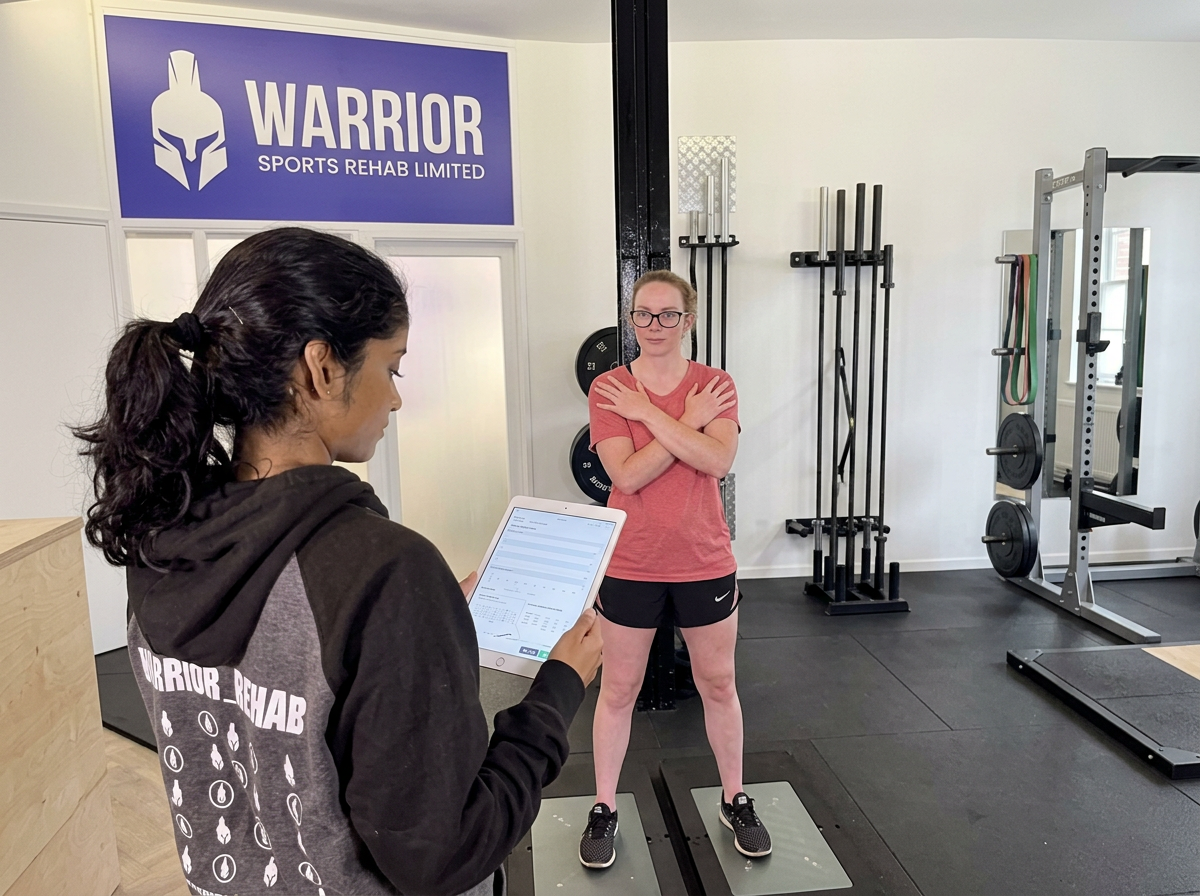
Physio Divya Shetty testing a female athelte for neurodynamic strength at our Gym
What does not move the needle
Passive stretching on its own, and standing on a wobble board without any load or task complexity, do not protect against the joint forces that show up in a competitive game. That is a common trap, because both feel productive and fill training time. The mechanism that reduces risk is teaching the athlete to absorb force through the hips and hamstrings, not the knee, under speed. Static work does not train that.
The menstrual cycle question
Whether the menstrual cycle changes ligament laxity enough to change injury risk on a given day is still debated. Parents ask me about this often. The current data is not consistent enough to build cycle-based prevention protocols on, so we do not try. Biomechanical strength work is the reliable lever.
If you are already dealing with a knee that keeps giving way or a recent ACL scare, book an assessment with our Shoreditch team.
Who this is for
Targeted ACL prevention is worth doing for adolescent and adult female athletes in high-deceleration, multi-directional sports: netball, football, basketball, rugby, and alpine skiing account for most of the non-contact tears I see. It is also worth doing for female athletes who never went through a structured strength programme in their teens, and for anyone whose landing mechanics have been flagged by a coach or a previous physio.
Honesty about limits: no programme guarantees you will not tear an ACL, particularly in unpredictable contact scenarios. What the programme changes is the non-contact risk, which is the majority of the tears in female sport. That is the number worth acting on.
What we do at Warrior
At Warrior Sports Rehabilitation in Shoreditch, an ACL prevention block starts with an assessment, not with a generic gym plan. I look at lower-limb injury history, training age, current load, and joint range of motion, and I read your landing pattern under video.
In clinic I most often see players with sharp agility and skill on the pitch but restricted ankle dorsiflexion, which forces the knee inward on a hard cut. Fixing the ankle is often the first unlock. From there, we work with objective numbers rather than a coach's eye alone. VALD Dynamometers give us peak isometric strength for quadriceps, hamstrings and glutes, and a rate-of-force-development figure that tells me how quickly you can produce force from rest. ForceDecks pick up asymmetry between the left and right leg during counter-movement and drop jumps, which is often the number that changes first as the programme takes hold.
Once the baseline is in, athletes progress their loading in our Open Gym under supervision, and we retest on the dynamometer monthly. The retest is not optional. It is how we know the neuromuscular work is translating, or whether we need to change the stimulus.
Physiotherapist Divya Shetty works at both of our Shoreditch clinics from Monday to Friday
FAQ
Why are female athletes more prone to ACL injuries?
Two reasons stack. Anatomical differences (narrower intercondylar notch, wider Q angle) put more mechanical stress on the knee. On top of that, common movement habits like dynamic knee valgus (inward knee collapse on landing) and quad-dominant jumping mechanics load the ACL harder during rapid deceleration. Only the second set is trainable, and it is where prevention work sits.
How can a female athlete prevent an ACL tear?
Targeted neuromuscular training run twice a week through a season cuts non-contact ACL injury rates by around two-thirds in female athletes (Webster and Hewett, Journal of Orthopaedic Research, 2018, PMID 29737024). The active ingredients are posterior-chain strength (glutes and hamstrings), landing and deceleration mechanics, single-leg control, and trunk stability. A supervised strength programme delivers all four.
What sports carry the highest ACL tear rate for females?
ACL injuries cluster in high-velocity, multi-directional sports with a lot of jumping and cutting. For female athletes, the highest non-contact tear rates are seen in netball, football, basketball, rugby and alpine skiing. If you play one of these regularly, prevention work is worth building into your week.
Does the menstrual cycle affect ACL injury risk?
Research is looking at whether hormonal shifts across the menstrual cycle change ligament laxity and injury risk, and there is a signal in some studies. It is not yet consistent enough to write cycle-based prevention protocols, so the reliable primary intervention stays the same: structured neuromuscular strength work, twice a week, through the season.
Practical next step
If you want to build lower-body resilience, sort out a landing pattern, or run a full screen ahead of a season, book an assessment at our Shoreditch clinic. We run the VALD and ForceDecks work as part of the initial screen so you leave with numbers, not a general prescription. Check the physiotherapy page for what a session covers, and the pricing page for session lengths.
By Divya Shetty, Physiotherapist (HCPC, MCSP), Warrior Sports Rehabilitation Shoreditch. Divya specialises in lower-limb biomechanics, objective strength testing, and return-to-play rehabilitation for field-sport athletes. Read her full bio. (https://www.warriorsportsrehab.com/divya-shetty)